
What Does a Good Flight Instructor Really Teach You?
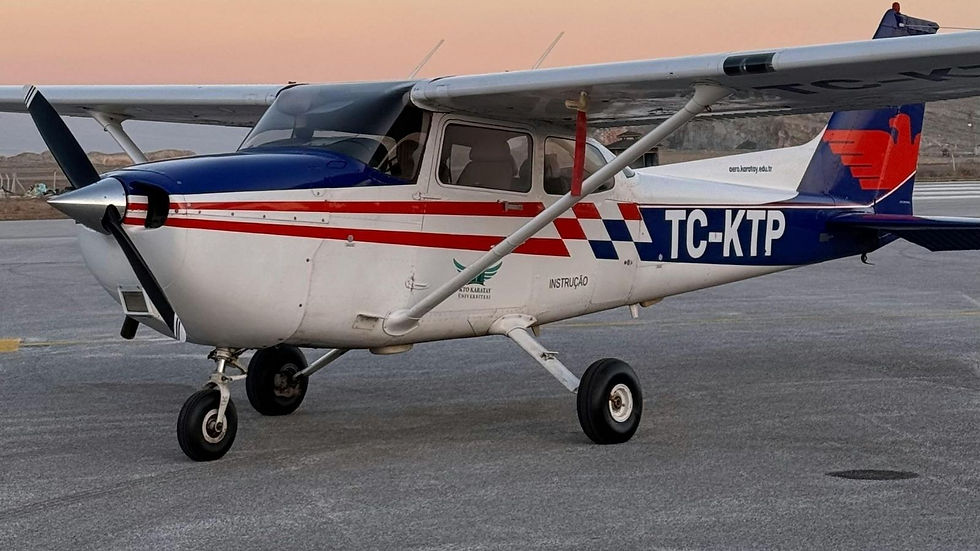
Ask most pilots about their first flight instructor and watch what happens. They smile. They remember a name, a voice, a particular way of saying "your airplane" when it was time to take the controls. Years later, long after they have logged thousands of hours, those early lessons are still rattling around in their head.
We were reminded of this recently listening to a pilot look back twenty five years at the instructor who shaped him. The flying was only part of it. The bigger things, the ones that stuck, were about judgment, responsibility, and quietly releasing the brakes when it was finally time to go.
So let us talk about what a good flight instructor actually teaches. Because if you are thinking about learning to fly here in Middle Tennessee, the stick and rudder skills are only the beginning of what you will walk away with.
Is flight training really just about flying the airplane?
Here is the honest answer: no. Flying the airplane is the easy part to describe and the hard part to master, but it is not the whole job.
Yes, you will learn to take off, climb, turn, descend, and land. You will learn to hold altitude within a tight margin and roll out on a heading like you meant to do it. Those are real, measurable skills, and we drill them until they become second nature.
But the airplane is also a classroom for something bigger. Every lesson quietly teaches you how to make decisions with real consequences, how to stay calm when things do not go to plan, and how to be honest about what you do and do not know.
We are not just teaching you to fly. We are teaching you to be the kind of person who should be trusted with an airplane.
That sounds heavy. In practice it feels wonderful, because every one of those skills makes you more capable and more confident, not just in the cockpit but on the ground too.
Why does "take responsibility" matter so much in the cockpit?
In an airplane, you are the pilot in command. That phrase is more than a title. It means the outcome of the flight rests with you.
New students sometimes expect the instructor to be a safety net who swoops in and fixes everything. We are there, and we will never let a lesson become unsafe. But a good instructor slowly hands you the responsibility, piece by piece, until one day you are the one who notices the fuel is lower than you would like, or the clouds over the Smyrna practice area are lower than the forecast promised, and you make the call.
That moment of ownership changes people. We have watched career changers and teenagers alike stand a little taller after the first time they caught something themselves and acted on it. **Responsibility is not a burden you carry alone. It is a muscle you build one lesson at a time.**
When is the right time to go around?
A go around is simple to explain. You are set up to land, something is not right, so you add power, climb away, and come back around to try again.
What makes it one of the most important lessons in all of flight training is what it represents. A go around is proof that you would rather be safe and slightly embarrassed than committed to a bad outcome.
We teach go arounds early and often. Here are the kinds of moments where the right answer is to simply try again:
The approach is too high or too fast and the runway is running out in front of you
A gust pushes you off centerline just before touchdown
An airplane or a deer or anything else is where it should not be
Something just feels wrong, even if you cannot name it in the moment
That last one matters most. **The willingness to abandon a plan is not weakness. It is one of the clearest signs of a good pilot.** Students who learn to go around without hesitation carry that instinct into the rest of their lives, where knowing when to reset and try again is every bit as valuable.
How do you learn to trust the people around you?
Flying feels solitary from the outside, like it is just you and the machine. It is not. You are part of a system full of people you will never meet, all working to keep you safe.
There is the controller at the tower here at KMQY, calmly sequencing you into the pattern. There is the mechanic who signed off the airplane. There is the voice on the radio giving you a traffic advisory. And there is your instructor in the right seat, who has been exactly where you are.
Learning to trust that web of people is part of becoming a pilot. You learn to ask for help on the radio instead of guessing. You learn that admitting "I am a student pilot and I would like that one more time" gets you patience and a slower, clearer instruction, every single time. Nobody in this community expects you to know everything on day one.
Trusting your instructor
Early on, trust means believing us when we say the airplane will fly just fine in a crosswind that feels alarming to you. Later, trust flips around. We trust you to fly solo, to make good choices when we are not there, to be honest in your logbook. That two way trust is the heart of the whole thing.
Why is flying something you never stop learning?
One of the quiet truths of aviation is that the certificate is not a finish line. When you pass your private pilot checkride, the examiner will likely tell you that your new certificate is a license to keep learning.
We mean that sincerely. The instrument rating teaches you to fly in the clouds and reads like a whole new language of precision. A tailwheel endorsement humbles pilots with thousands of hours. Every new airplane, every new airport, every unfamiliar weather pattern over the Cumberland Plateau is a fresh lesson.
The best pilots we know are the ones who still consider themselves students.
This is good news if you worry you are not a natural. You do not need to be. You need to be curious and willing to keep showing up. The pilots who thrive are rarely the ones who found it easy at first. They are the ones who kept coming back.
What do you do when training gets hard?
It will get hard. We want to be straight with you about that, because nobody benefits from a fairy tale.
Almost every student hits a plateau. Landings that were clicking suddenly fall apart for a week. A maneuver that should be simple keeps sliding out of tolerance. Life gets busy, weather cancels three lessons in a row, and the airplane starts to feel far away.
Here is what we have learned from teaching through all of it: those rough patches are not a sign you are failing. They are a normal part of how the brain builds a complex skill. The frustration usually comes right before a breakthrough. We have seen a student leave a lesson convinced they would never land the airplane, then grease three in a row the following week like they had done it their whole life.
Persevering through the setbacks is the lesson. **Flying does not reward the people who never struggle. It rewards the ones who keep their hand on the throttle and go again.**
And sometimes, you just release the brakes
There is a moment on the very first lesson that we never get tired of watching. You are at the end of the runway, engine run up complete, cleared for takeoff. Your hand is on the throttle. And for just a second, the whole thing feels enormous and a little unreal.
Then you release the brakes and push the power in, and the airplane starts to roll, and Middle Tennessee begins to drop away beneath the wheels.
That is the real lesson under all the others. At some point you stop planning to fly and you simply go. You trust the training, you trust the people around you, and you let the airplane do what it was built to do.
If you have been circling the idea of learning to fly, telling yourself maybe next year, we understand. We were all there once. When you are ready, come out to Smyrna and sit in the left seat with one of us. The first lesson will teach you something about an airplane. It might also teach you something about yourself.


